
Placental Adhesive Disorders: A Comprehensive Overview
Placental adhesive disorders (PAD), also referred to as placenta accreta spectrum (PAS), are serious obstetric conditions characterised by abnormal adherence or invasion of the placenta into the uterine wall. These conditions have become increasingly important in modern obstetrics due to rising cesarean section rates and associated maternal risks.
Definition and Classification
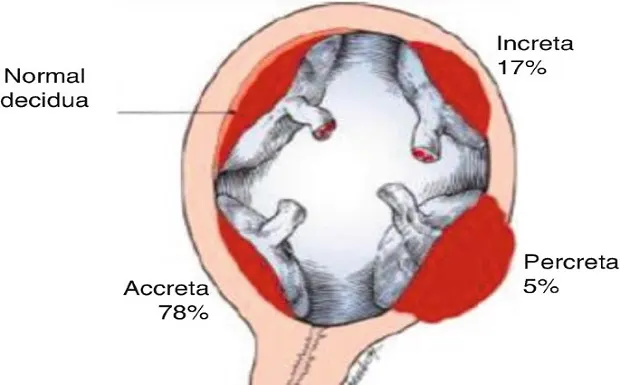
Placental adhesive disorders occur when placental villi abnormally attach to or invade the myometrium instead of remaining limited to the decidua basalis. Based on the depth of invasion, they are classified into placenta accreta, increta, and percreta. Placenta accreta involves superficial attachment, increta shows deeper invasion into myometrium, while percreta penetrates through uterine wall and may involve adjacent organs.
Epidemiology and Risk Factors
The incidence of PAS has increased due to higher cesarean delivery rates. The most significant risk factor is previous cesarean section, especially when associated with placenta previa. Other risk factors include previous uterine surgery, multiparity, advanced maternal age, and assisted reproductive techniques.
Pathophysiology
The underlying mechanism involves defective decidual formation at the site of placental implantation. This allows trophoblastic invasion deeper into the uterine wall. Increased vascularity forms abnormal blood vessels, leading to difficulty in placental separation and severe hemorrhage at delivery.
Clinical Features and Diagnosis
Patients may remain asymptomatic during pregnancy. Suspicion arises in women with risk factors. Diagnosis is primarily done using ultrasound, showing placental lacunae, thinning of myometrium, and abnormal vascularity. MRI helps assess the extent of invasion.
Complications
The most serious complication is massive obstetric hemorrhage. Other complications include shock, DIC, multi-organ failure, and surgical injuries to bladder or ureters. Placental adhesive disorders are a leading cause of peripartum hysterectomy.
Management
Management requires a multidisciplinary approach. Planned cesarean hysterectomy with placenta left in situ is considered the gold standard. Conservative methods like leaving placenta in situ may be used to preserve fertility but carry risks.
Prognosis
Outcome depends on early diagnosis and availability of skilled care. While mortality is reduced with proper management, morbidity remains high due to hemorrhage and surgical complications.
Conclusion
Placental adhesive disorders represent a significant challenge in modern obstetrics. Early recognition, careful planning, and multidisciplinary care are essential for improving outcomes and reducing maternal morbidity and mortality.