
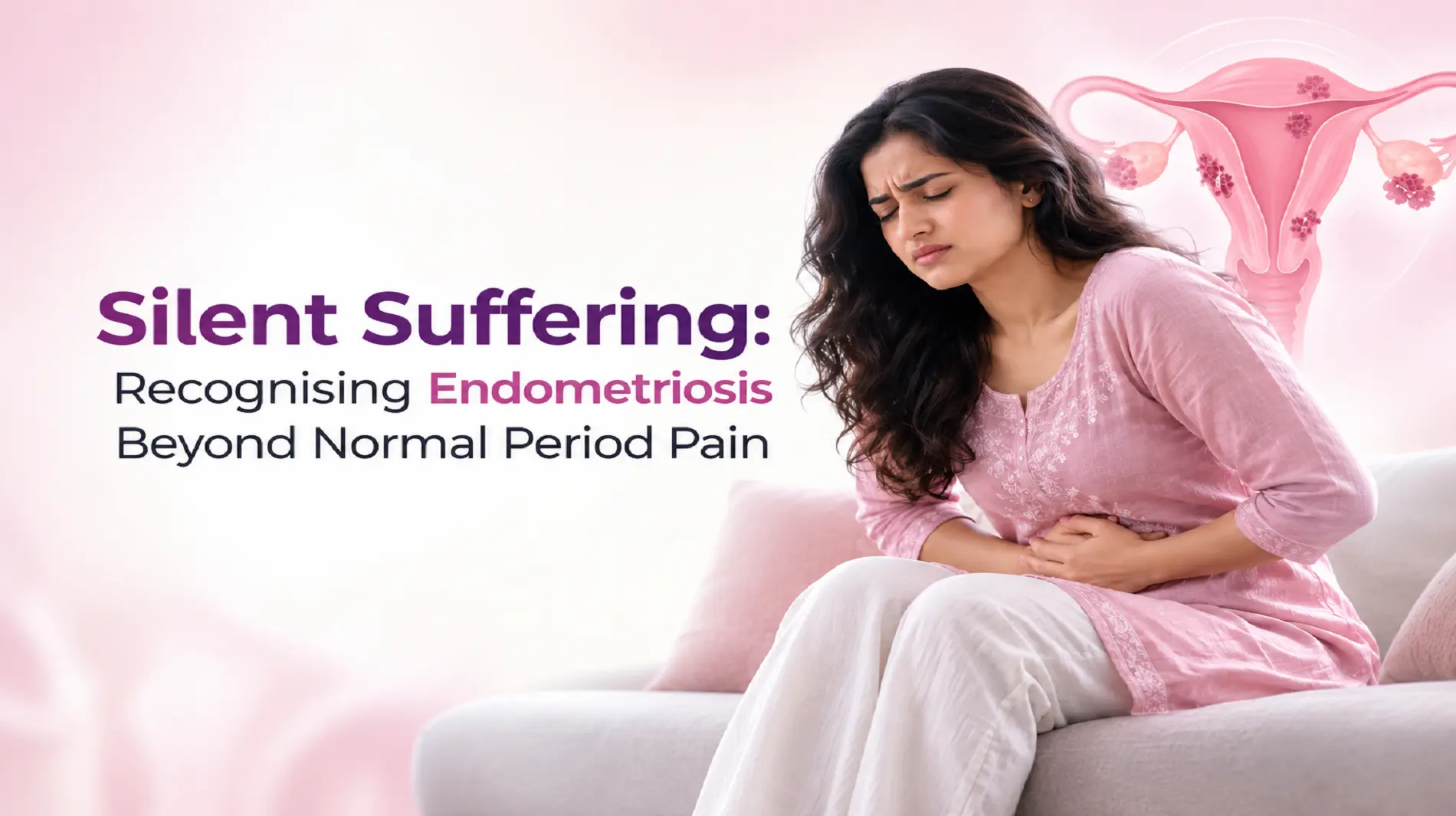
Silent Suffering: Recognising Endometriosis Beyond Normal Period Pain
A painkiller before the pain even starts. A heating pad kept at the desk. A practiced smile through cramps that feel like something twisting inside — because everyone has said periods are supposed to hurt.
That's the kind of silent suffering many women with endometriosis experience. Not silence because nothing is being said, but because severe symptoms are too often treated as something women simply have to live with.
If you've ever wondered whether your period pain is “too much,” the answer may be worth exploring.
What Is Endometriosis?
Endometriosis is a condition in which tissue similar to the lining of the uterus grows outside the uterus. It can affect the ovaries, pelvic lining, bowel, bladder and other areas.
This tissue responds to hormonal changes during the menstrual cycle. The resulting inflammation can contribute to pain, scarring and adhesions.
Endometriosis is not simply a bad period. Looking at it as a broader pelvic condition helps explain why symptoms can occur outside menstruation too.
How Can You Tell Normal Period Pain From Something More?
Some menstrual discomfort is common. The pattern becomes more concerning when pain is severe, persistent or repeatedly interferes with everyday life.
- Typical period pain often starts around the beginning of the period, settles within a few days and responds reasonably well to usual pain relief.
- Endometriosis-related pain may begin several days before bleeding, continue after the period, respond incompletely to usual painkillers and be severe enough to interfere with work, school or daily activities.
- Pain that feels deep or is associated with other pelvic, bowel, bladder, sexual or fertility symptoms deserves assessment.
Endometriosis Symptoms Beyond Period Pain
Endometriosis can affect areas beyond the uterus, which is one reason it may take time to recognise.
- Bloating, constipation, diarrhoea or nausea that worsens around menstruation.
- Pain during bowel movements or urinary pain that follows a cyclical pattern.
- Lower back, thigh or one-sided leg pain that flares around the menstrual cycle.
- Pain during or after intercourse, particularly with deep penetration.
- Fatigue that does not improve with rest.
- Mood changes, anxiety or migraines that seem to track with the menstrual cycle.
- Difficulty conceiving.
Why Can Endometriosis Go Undiagnosed for Years?
There are several reasons. Severe period pain is often normalised, symptoms can resemble gastrointestinal or urinary problems, and there is no single simple test that confirms every case.
- Pain is dismissed as a normal part of menstruation.
- Bloating, bowel symptoms or fatigue may be attributed to other causes.
- A normal scan does not necessarily exclude all endometriosis.
- Symptoms can vary significantly from one woman to another.
- Some women have very few obvious symptoms.
When Should You See a Gynecologist?
- Period pain that interferes with work, school, relationships or daily activities.
- Pain that does not improve adequately with usual pain relief.
- Pain during or after intercourse.
- Bowel or bladder pain that becomes worse around your period.
- Persistent fatigue or bloating associated with your cycle.
- Difficulty conceiving.
- A close family history of endometriosis.
How Is Endometriosis Diagnosed?
Diagnosis starts with a detailed history. The timing, pattern and impact of symptoms are important, not just the intensity of pain.
- Pelvic examination when appropriate.
- Transvaginal ultrasound to identify endometriomas and some deep lesions.
- MRI when detailed mapping of deep or extensive disease is needed.
- Laparoscopy in selected cases, which can allow direct visualisation and treatment during the same procedure.
How Is Endometriosis Treated?
Treatment is not one-size-fits-all. The right approach depends on symptoms, disease extent, age, fertility plans and previous treatment.
- Pain management with appropriate medication.
- Hormonal treatment to control symptoms and disease activity.
- Laparoscopic surgery for selected women with significant disease or symptoms.
- Fertility treatment when conception is difficult.
- Pelvic floor physiotherapy and other supportive approaches for selected women with chronic pelvic pain.
You Don't Have to Prove Your Pain Is 'Bad Enough'
You do not need to wait until the pain becomes unbearable before seeking help. If period pain or related symptoms are interfering with your everyday life, that is a reasonable reason to talk to a gynecologist.
Endometriosis is common and manageable with appropriate care. Recognising the pattern earlier can help women move from repeatedly coping with symptoms to understanding and treating the underlying condition.
Expert Endometriosis Care at Ankura Hospital
At Ankura Hospital for Women & Children, gynecology teams evaluate persistent pelvic pain, painful periods, fertility concerns and other symptoms that may be associated with endometriosis. Care is planned around the woman's symptoms, reproductive goals and clinical findings, with imaging and minimally invasive surgical options considered when appropriate.