Top 10 Signs of Autoimmune Disease in Children
Parents try to keep their children away from any harm coming their way. They constantly monitor their growth and development and watch for signs of illness. However, there are a few diseases in children that they find very hard to diagnose. One of these is autoimmune disease, entailing a group of intricate disorders whereby the body’s immunity stages an attack against a number of healthy cells, tissues, and organs of the body.
Autoimmune Disease in Children

When the immune system begins to attack the body’s healthy cells, tissues, and organs, results in development of autoimmune (rheumatic) disorders.
Even though autoimmune diseases are typically linked to adults, parents should be aware that children can also be affected by similar conditions, which tend to be much severe in kids. This group of diseases is often challenging to diagnose and difficult to treat in children.
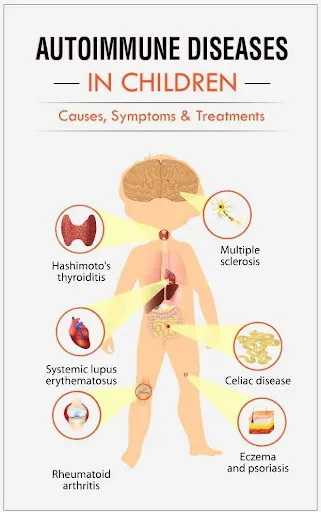
The common autoimmune diseases affecting children include various subtypes of juvenile idiopathic arthritis, or JIA, a type of arthritis that lasts at least six weeks in children under the age of sixteen years; connective tissue disorders like systemic lupus erythematosus, dermatomyositis, vasculitis disorders like Kawasaki disease and Henoch schonlein purpura
Autoimmune diseases can cause problem in a single specific organ and cause organ-specific diseases (also known as localized) like liver and skin. However, most rheumatological diseases cause systemic involvement i.e., problems throughout the body. For example,
-Juvenile idiopathic arthritis affects the skin, eyes, blood, and other organs like lung in addition to the joints
-Juvenile dermatomyositis affects the muscles and skin
– Lupus causes multiorgan involvement: kidneys, joints, skin, heart, brain, liver
– Lupus causes multiorgan involvement: kidneys, joints, skin, heart, brain, liver
Top 10 Signs of Autoimmune Disease in Children

Fever – prolonged or recurrent
Pain, swelling, and stiffness in the joints
Limping of child
Weakness and pain in muscle
Loss or brittleness of hair
Skin rashes – butterfly shape across the cheeks, rash on eyelids, elbows, salmon pink rash on trunk, psoriasis, etc
Loss of weight without an apparent reason
Ongoing fatigues for which a cause cannot be identified
Poor growth
Swollen lymph glands
Enlarged liver and spleen
Redness of eyes, decrease in vision- uveitis
Changes in behavior and mood
Changes in behavior and mood
Multiorgan involvement
What Causes Autoimmune Disease?
Unknown is the precise cause behind some children’s immune systems attacking their own bodies. We do know that there is no known etiology of autoimmune disorders, and they are not communicable. Scientists, on the other hand, think that a few steps are involved:
Heredity: Some children are susceptible to an autoimmune disease due to specific genes that are inherited from their parents.
Environmental factors: Unless an infection, exposure to sun, or other trigger occurs, an autoimmune disease may not manifest itself first.
Hormonal factors: Since many autoimmune disorders affect young women and girls in their adolescence, female hormones may also be involved in the onset of many diseases.
How are autoimmune diseases diagnosed?
Pediatricians have unique challenges while dealing with autoimmune disorders. Fever and fatigue are two of the first symptoms that are often generic, meaning they can occur in a wide range of conditions. Many times, symptoms come and go. A single autoimmune disease may present differently in each individual or might possess characteristics with several autoimmune disorders.
A pediatric rheumatologist will first do a comprehensive physical examination and review your child’s whole medical history, including any family history of autoimmune disease. The physician might suggest further lab tests to obtain more details if they suspect an autoimmune condition.
Complete blood count” (CBC) refers to a group of laboratory tests used to determine the size, quantity, and maturity of various blood cells in a given volume of blood.
The liver produces a unique protein, which is measured by the C-reactive protein (CRP). When there is significant inflammation, such as that observed in autoimmune diseases, anywhere in the body, CRP levels usually rise. The initial CBC, ESR AND CRP give a clue towards provisional diagnosis. Further testing on specific tests might be needed in symptoms
The immune system produces abnormal proteins, when it attacks its own tissues. Antinuclear antibody (ANA) and Rheumatoid factor (RF) are one among those.
In order to rule out conditions like infections, tumors, and fractures, the doctor might also choose to examine your child’s organs and tissues more closely. Imaging tests like Magnetic resonance imaging (MRI) and ultrasound will be needed.
Sometimes, in order to diagnose the illness or obtain an indication of how it is developing, your child’s physician will actually take a sample of your child’s tissues, a procedure known as a biopsy.
How are Autoimmune Diseases Treated?
Pediatric rheumatologists are often the primary carers for patients with autoimmune diseases. The care of your child may involve other experts such as a dermatologist (skin), hepatologist (liver), and a nephrologist (kidneys), depending on which tissues or organs are affected. Most autoimmune disorders have no known cure; clinicians strive to do much more than simply treat your child’s symptoms can be well controlled with proper treatment and can lead a normal life.
Your doctor will prescribe medications that combat the damaging inflammation brought on by an autoimmune attack by controlling the immune system.