
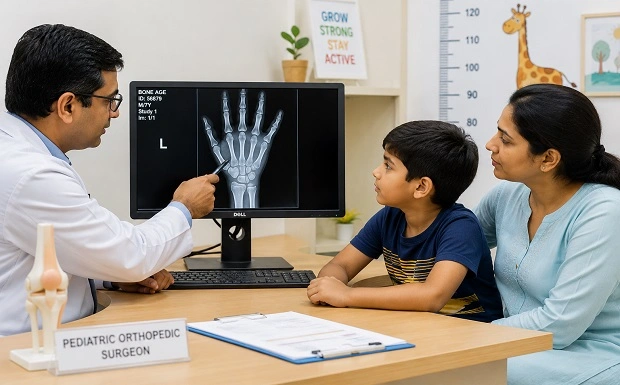
X-Ray Exam: Bone Age Study
When it comes to children’s growth, every parent has questions—is my child growing normally? Are they too short for their age? Is puberty happening too early or too late?
One straightforward, yet highly effective, tool physicians utilize to address these questions is the bone age study, a specific type of X-ray. Let's explore what it entails, its significance, and what you might anticipate.
What Is a Bone Age Study?
Essentially, it's a low-dose X-ray, usually of the left hand and wrist, used to evaluate a child's skeletal development. Rather than looking at a child's age in years, this test measures how far along their bones are in terms of maturation.
Consider this: two children could both be ten years old, but their bone development might not be the same. One may have bones resembling an 8-year-old, while another may match a 12-year-old.
Why Do Doctors Recommend a Bone Age X-Ray?
You might be wondering, "Why does my child need this test in the first place?"
Doctors often turn to a bone age X-ray when there is uncertainty about a child's growth or development. It's a straightforward method for gaining a clearer understanding of what's going on within the body, beyond the surface observations.
Consider, for instance, the situations where your child's doctor might recommend this test:
- Your child is shorter than expected or seems to be growing more slowly than their friends.
- Your child is experiencing rapid growth or is unusually tall for their age.
- Signs of either early or delayed puberty are present.
- Hormonal imbalances are a possible concern.
- Chronic health issues that could impact growth are present.
- Monitoring is needed for ongoing growth hormone therapy.
Ultimately, this test assists doctors in addressing a key question:
Is your child's growth trajectory typical, or does it warrant further examination?
The findings dictate what happens next: perhaps a bit of comfort, a deeper look, or prompt care.
How Is the Test Done?
If you're feeling a bit uneasy, let us ease your mind—it’s a straightforward process, designed with children in mind.
Your child's hand, typically the left, is carefully positioned on an X-ray plate. The technician then captures a single image, a process that takes mere seconds.
There's no need for shots, no discomfort, and no special preparations are required. Most children go through it comfortably without any stress. Another key consideration is the low level of radiation involved, which makes the procedure safe when used correctly. It's a brief process that offers useful information about your child's development.
How Are the Results Interpreted?
After the X-ray, you might be curious about what the doctors are actually examining.
The image is carefully examined using standard reference materials, like the Greulich and Pyle atlas, which shows the typical development of bones at different ages.
Your doctor doesn't simply scan the X-ray; they meticulously examine several key aspects. These include the bones' dimensions and contours, the growth plates—those areas where bone development is ongoing—and the extent of bone fusion, which reveals how close the bones are to reaching their full size.
From this, the findings are interpreted in a straightforward manner:
If the bone age aligns with your child's chronological age, growth is typically proceeding as expected. A bone age that's lagging behind could mean your child is simply developing more slowly, or it might point to hormonal factors at play. On the other hand, a bone age that's ahead of schedule might be a sign of early puberty or other problems connected to the endocrine system.
All of this information provides doctors with a more comprehensive understanding of your child's growth trajectory.
It also helps forecast future height and determine if treatment or additional assessment is warranted.
What does bone age reveal about your child's growth?
Bone age, at first glance, seems like just another number on a medical report. Yet, it offers a glimpse into the complex narrative of your child's evolving self. It assists doctors in understanding not only your child's current growth but also what lies ahead.
For instance, it can give a fairly good idea about your child’s adult height potential, which is something many parents are naturally curious about. It also plays an important role in picking up growth delays early, sometimes even before they become obvious. This early insight allows doctors to look into possible causes, including hormonal or endocrine conditions, and take action if needed.
Bone age also plays a crucial role in shaping treatment plans. This assessment helps in deciding whether to start hormone therapy, adjust current treatments, or simply watch how growth progresses. It's a useful resource for making smart choices.
And here's a comforting thought: a delayed bone age isn't automatically a red flag.
In many cases, it simply means your child is a “late bloomer” and may catch up with time.
Is the Bone Age Test Safe?
A very common question parents have is—"Is this test safe for my child?”
The answer is yes, a bone age X-ray is considered very safe. It uses low-dose radiation, much lower than many other imaging tests, and the exposure lasts only a few seconds.
It's also a relief to know the process is both fast and straightforward, and it comes with no adverse reactions. Your child won’t feel any discomfort during or after the test.
Doctors exercise caution, recommending this test only when it's truly warranted. We aim to make certain that the benefits of understanding your child's development far outweigh any possible downsides.
When Should Parents Start to Worry?
Even though children develop at different rates, certain signs might suggest that closer observation is needed. If you notice any of these signs, it could be a good idea to consult a professional:
- Your child is significantly shorter or taller than their classmates.
- Puberty is delayed, arriving later than usual.
- Puberty's initial stages can surface early, sometimes before a girl turns eight or a boy nine.
- Children often experience sudden growth spurts, or sometimes, their growth may slow down noticeably.
Even though these changes don't always indicate a major problem, they still require careful consideration.
An early assessment can truly make a difference. It allows for the swift pinpointing of possible problems, ensuring your child receives the appropriate support or intervention when it's most beneficial.
Why Is Early Diagnosis Crucial?
Catching growth-related issues early often facilitates management. Growth-related issues are often much easier to manage when identified early. Early detection is crucial because it allows for medical intervention at a stage when treatment is most successful.
Spotting a problem early can also prevent potential complications. More often than not, though, the greatest advantage is the peace of mind it offers. When the results come back normal, it puts worries to rest and avoids unnecessary stress.
While it might appear straightforward, a bone age assessment offers valuable information about a child's growth and development, helping to ensure they stay on a healthy path.
Why Choose Ankura for Pediatric Orthopedics?
At Ankura Hospital for Women & Children, we know how deeply worrying it can be for parents when they have concerns about their child's development. Our pediatric orthopedic specialists work hand-in-hand with pediatric endocrinologists and radiologists. This collaborative approach enables us to provide accurate diagnoses and customized treatment plans. Ankura is committed to providing every child with the appropriate assessment and treatment, precisely when they need it. We achieve this through the use of advanced imaging technology, the creation of child-friendly environments, and a collaborative approach to care. Whether we're tracking developmental progress or addressing intricate orthopedic concerns, our focus remains on supporting your child's well-being at every stage of their development.