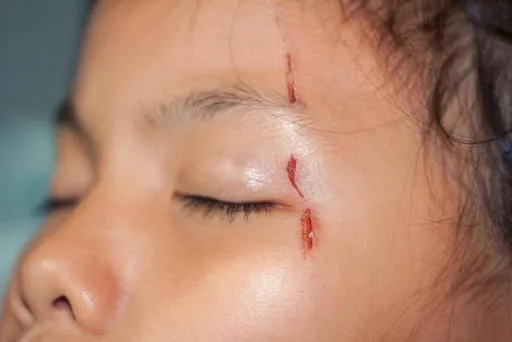
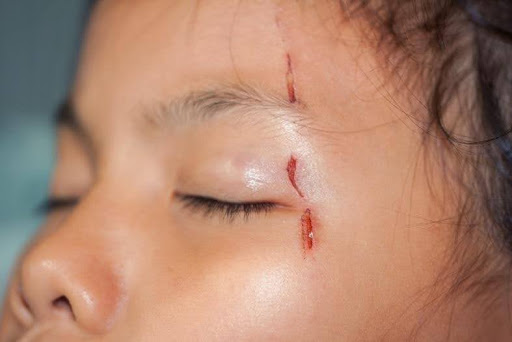
Scenario: A 4 year old boy sustains an injury to the forehead while playing with his sibling by hitting the edge of a door in his house. There is a wound on the right eyebrow and is bleeding profusely. The mother gets panicked and rushes him to a nearby hospital.
This is a very common scenario particularly in young children seen almost on a daily basis. So let’s discuss about pediatric facial lacerations– i.e. cuts over the face in children and attempt to answer some of the common concerns of the parents.
What should I do when my child accidentally sustains a cut over the face?
Firstly, do not panic. Try to comfort your child.
DO NOT feed the child in an attempt to calm the child down.
Note the site and number of cuts and look for any active bleeding.
Apply pressure with a clean cloth, or a guaze for 5 to 10 minutes. Do not repeatedly lift the cloth/guaze to see the wound as the clot formation process will be interrupted.
Wash the wound with water to remove any dirt or foreign bodies, but don’t scrub the site.
Visit your nearby hospital after covering the wound with a clean cloth/guaze dressing.
When would a specialist be required to assess my child? Remember: A B C D E
Animal bites
Bleeding without stopping after 10 minutes of direct pressure, or that start to bleed again.
Crooked edges
Deep or long wounds more than 5mm
Embedded with debris, such as dirt, stones, or gravel that remain after washing.
Will all lacerations require surgery? Suture repair is warranted in cases where laceration extends through the dermis and where apposition of wound edges, promote wound healing and improve outcomes. This is done by a specialist after thorough assessment in a procedure room in the emergency or a minor operation theatre.
Those that are superficial, clean and in no/low tension areas of the face can be managed by through cleaning and tissue adhesive/skin glue application.
What are the goals of surgery for facial lacerations?
The goal is to approximate wound edges with minimal compromise of skin integrity or function ideally within 18 hours of injury, at the most within 24 hours. This will help in prevention of wound infection and in subsequently reduce the chance of developing a prominent scar.
Will my child develop an ugly-looking scar after surgery?
Every child is different and similarly every wound is different. It is nearly impossible to predict the kind of scar that a particular child with a particular wound can develop.
Having said that, all measures will be taken by your treating specialist to minimise the chances of developing a prominent scar – thorough toileting of the wound to remove any dirt or gravel that can cause intense inflammation, trimming of loose/uneven skin edges, multilayered closure to provide strong support to the overlying skin and avoiding tight knots are some of them.
Some children genetically have a prominent scar (=keloid) forming tendency. This subset of children might require subsequent treatment of those scars by other methods like topical creams, local steroid injections, lasers etc.
Will my child have pain during or after the procedure?
Absolutely not. Your team of doctors will ensure your child remains pain-free throughout the hospital experience. From administering a local anesthetic cream before the insertion of an IV cannula to discharge on oral pain-killer medication, there are several modes of administering medication to prevent pain.
Older children usually co-operate for surgery under local anesthesia, whereas younger and apprehensive children require sedation to keep the child calm and free from pain. In the latter group, your specialist will still administer local anesthetic agents to prevent pain as soon as the child wakes up after procedure.
How long should my child be kept in the hospital after the procedure?
A child who undergoes suturing done under local anesthesia can be discharged right after the procedure, while a child who was sedated requires a short 4-6 hour hospital stay and then will be discharged.
What is the recommended diet after surgery?
There is no diet restriction following this procedure.
For children with wounds inside the oral cavity including the inside of lip, gums, cheek, tongue etc., your doctor might advise giving your child ice-creams and avoid hot liquids/solids for 48 hours.
Our healthcare specialists are equipped with the knowledge and skills to provide you with the support you require. From consultation to diagnosis to treatments, our experts are dedicated to helping you.